
The Privilege Ladder: How to Use Discord Roles and Exclusive Events to Drive Retention

The most retained Discord communities in the world share a design principle that most brands have never applied: they make participation feel like progress. Members are not just chatting — they are advancing through a system where their activity has visible, meaningful consequences for what they can access and who they are within the community.
This is the Privilege Ladder — a framework for designing Discord server roles as a progression system, where every tier unlocks exclusive access that cannot be bought, only earned. It turns passive members into active participants, active participants into advocates, and advocates into community infrastructure.
What Is the Privilege Ladder?
The Privilege Ladder is a role-based progression system where each tier of server membership unlocks increasingly exclusive access — events, channels, content, and experiences — in exchange for demonstrated contribution to the community.
The core mechanic is simple: members who contribute more get access to things that less-active members cannot reach. That exclusivity is not a punishment for the less active — it is a visible, aspirational destination that motivates progression.
Unlike gamification systems built around points or badges, the Privilege Ladder uses the community's own architecture as the reward. The prize is not external — it is access to a better version of the same community you are already in.
Why Exclusive Access Works Better Than Generic Rewards
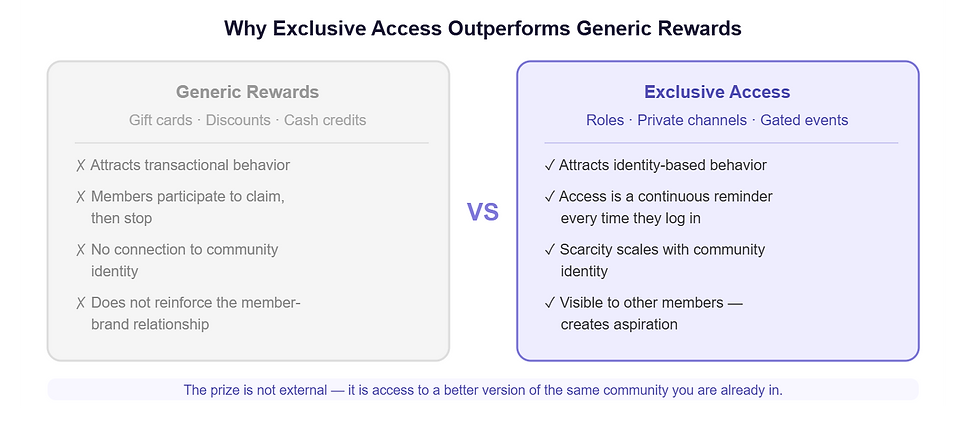
Generic rewards — gift cards, discounts, merchandise — create transactional behavior. Members participate to claim the reward, then stop. The reward has no connection to community identity, so it does not reinforce the relationship between member and community.
Exclusive access creates identity-based motivation. A member who holds the Contributor role has earned something that other members can see and that most members cannot have. Their Discord identity — their username badge, their channel access, their presence in spaces others cannot enter — is the reward. That identity is continuously reinforced every time they log in.
This is why role-gated events consistently outperform open giveaways for retention: the event is not just a prize, it is a destination that makes the journey of contribution worth taking.
Designing the Privilege Ladder: Four Tiers
A practical Privilege Ladder for most brand Discord communities has four tiers. Each tier has a clear name, transparent entry requirements, and specific privileges that genuinely justify the effort to reach it.
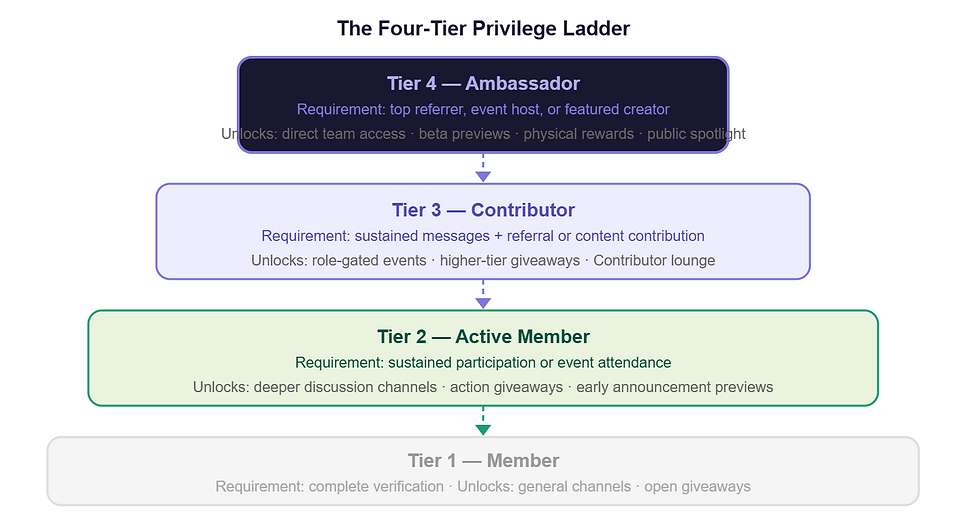
Tier 1: Member
Entry requirement: complete server verification.
What it unlocks: access to general community channels, open giveaways, and public events. This is the baseline — a signal that the member has made a minimum commitment to the community.
Design principle: make verification frictionless but not absent. A single button click is enough. The act of opting in matters more than the difficulty of the task.
Tier 2: Active Member
Entry requirement: 30 messages or attendance at one community event within the first 30 days.
What it unlocks: access to deeper discussion channels, action-based giveaways, early announcement previews, and eligibility for community spotlight recognition.
Design principle: the threshold should feel achievable within a week of genuine participation. Members who engage naturally for a few days should hit this without trying.
Tier 3: Contributor
Entry requirement: 100 total messages, at least one active referral, or a qualifying contribution such as community content, detailed feedback submission, or event co-hosting.
What it unlocks: access to role-gated events (exclusive AMAs, product previews, private sessions), higher-tier giveaway eligibility, a dedicated Contributor channel, and visible recognition in the community leaderboard.
Design principle: this is the tier where the Privilege Ladder's power becomes real. The privileges here should be things that non-Contributors visibly notice and genuinely want. If members at Tier 2 are not aware that Tier 3 events are happening, the incentive is invisible.
Tier 4: Ambassador
Entry requirement: top referrer in the last 90 days, event co-host, or featured community content creator — nominated or identified by the team.
What it unlocks: direct access to the founding team, co-branding and collaboration opportunities, early beta access to unreleased product features, physical rewards, and public recognition across the brand's channels including social media.
Design principle: Ambassador should feel genuinely rare. If more than 2–3% of your community holds this role, it loses its signal value. Scarcity is what makes it worth pursuing.
How to Design Role-Gated Events That Drive Engagement
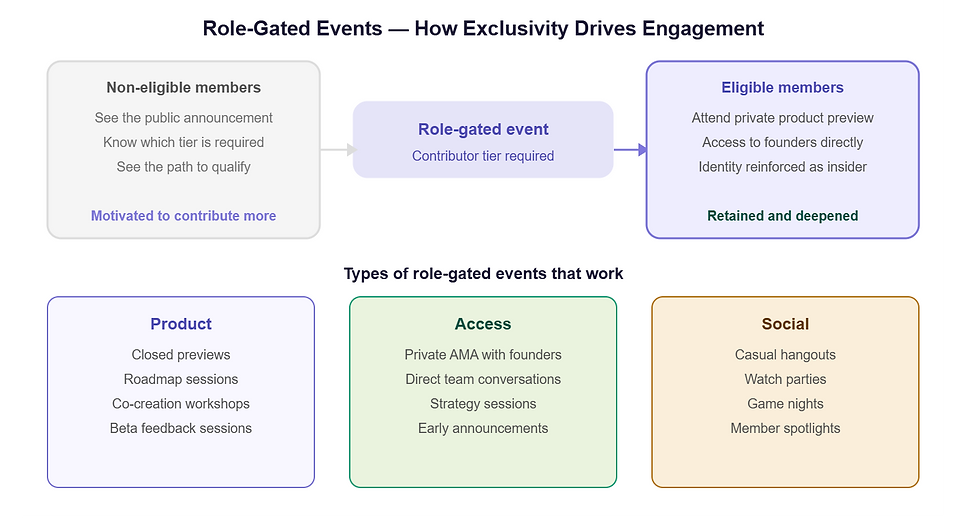
Role-gated events are the most powerful mechanic in the Privilege Ladder system. A well-designed gated event does two things simultaneously: it rewards members who are already at the required tier, and it creates visible motivation for members who are not yet there.
Making Exclusivity Visible
The event needs to be announced publicly before it happens — so members at lower tiers know what they are missing. Post the announcement in the general announcements channel with the role requirement clearly stated. Include a note on how to reach the required tier. This turns every exclusive event into a recruitment tool for the tier below it.
Example announcement language: this week's exclusive product preview AMA is open to Contributors and above. If you are an Active Member, you are closer than you think — check the contribution-requirements channel to see what you need to qualify for next month's session.
Types of Role-Gated Events That Work
Closed product previews: early access to features before public launch, with feedback collected from attendees. Combines exclusivity with genuine utility for the brand.
Private AMAs with founders or team leads: intimate sessions where contributors can ask questions that would not get answered in a public format.
Strategy or roadmap sessions: share direction, gather input, and make contributors feel like genuine stakeholders in the product's future.
Co-creation workshops: collaborative sessions where contributors help shape marketing campaigns, community programming, or product features.
Social events: casual hangouts, game nights, or watch parties that are simply more fun at a smaller scale with people who have demonstrated investment in the community.
Frequency and Cadence
Role-gated events work best as a monthly anchor — one significant exclusive event per month that contributors know to expect. Supplemented by smaller, more frequent touchpoints for ambassadors. Too many gated events dilutes the scarcity. Too few makes the tier feel abstract rather than actively rewarding.
How to Communicate the Privilege Ladder to Members
A progression system that members cannot see is not a progression system — it is just a set of internal labels your team uses. Transparency is what makes the Privilege Ladder work.
Publish a dedicated channel (call it roles-and-rewards or community-ladder) with a pinned post that clearly lists every tier, its requirements, and its privileges. Update this whenever anything changes.
Include the ladder overview in your onboarding welcome DM so new members understand from day one that participation has visible, meaningful rewards.
Announce when members reach a new tier — a public congratulations in the announcements or community-spotlight channel. This makes the progression visible to everyone and models what active participation looks like.
Send a personalized DM to members who are close to a tier threshold, letting them know what they need to do to qualify for the next exclusive event.
FAQ
What is a Discord role progression system?
A Discord role progression system is a structured tiered membership design where members earn roles by demonstrating contribution to the community — through activity, referrals, content creation, or event participation. Each role unlocks access to channels, events, or experiences that lower-tier members cannot reach. The system creates ongoing incentive to participate rather than go dormant.
How do you make Discord roles meaningful for brand communities?
Discord roles become meaningful when they unlock things members genuinely want that they cannot get without them. Access to a private product preview, a direct conversation with the founding team, or a dedicated channel for serious contributors is more motivating than a colored username. The value of the role is determined by the value of what it unlocks — design the privileges first, then design the requirements.
How many role tiers should a Discord community have?
Four to six tiers is optimal for most brand communities. Fewer than four produces insufficient progression incentive — members reach the top quickly and have no further motivation. More than six creates confusion about requirements and dilutes the signal value of each tier. The most important design constraint is that each tier should unlock something genuinely distinct and valuable.
What is the difference between a role-gated event and an open event?
An open event is accessible to all members regardless of activity or contribution. A role-gated event requires holding a specific role — earned through community participation — to attend. Role-gated events are smaller, more intimate, and more valuable to attendees because of the shared context among participants. They also create motivation for non-eligible members to increase their participation to qualify for future events.
The Bottom Line
The Privilege Ladder is not a loyalty program with points and badges. It is an architectural decision about how your community is experienced by different members at different levels of investment. When the architecture is designed deliberately — with real privileges at each tier and transparent requirements for reaching them — the community's own structure becomes its most powerful retention tool.
Members who feel like they are progressing toward something stay. Members who feel like they are participating in a flat, undifferentiated chat room leave when something more interesting comes along. Build the ladder, make it visible, and let the community climb.


Comments